
Table of Contents
- What Is the ICT Turtle Soup Setup?
- Why Is It Called the Turtle Soup Setup in ICT?
- When Does the ICT Turtle Soup Setup Form?
- How Does the ICT Turtle Soup Setup Work?
- What Are the Key Components of a Valid Turtle Soup Setup?
- What Is a Bullish ICT Turtle Soup Setup?
- What Is a Bearish ICT Turtle Soup Setup?
- What Is the Role of Liquidity in the Turtle Soup Setup?
- How Is the Turtle Soup Different from the ICT Judas Swing?
- How Is the Turtle Soup Different from a Liquidity Grab?
- What Are the Most Common Mistakes in Trading the ICT Turtle Soup?
- Which Markets Work Best for the ICT Turtle Soup Setup?
- Can Beginners Trade the ICT Turtle Soup Setup?
- Frequently Asked Questions
The ICT Turtle Soup setup is a reversal trading model where price raids a well-known level — such as a previous day high or low — collects the stop orders clustered just beyond it, and then reverses sharply back inside the range. The trader does not enter on the breakout. The trader enters after the breakout fails.
What Is the ICT Turtle Soup Setup?
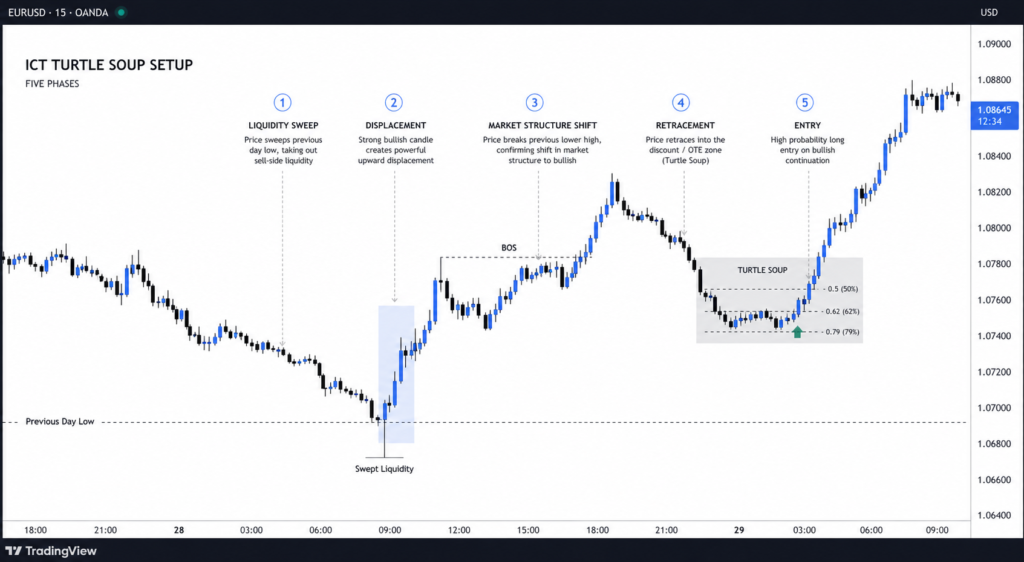
The ICT Turtle Soup is a liquidity-driven reversal setup built on the premise that breakouts at obvious price levels frequently fail because those levels exist primarily as liquidity pools, not as genuine structural boundaries. When price breaks a previous day high or a session low, retail traders react to the momentum. They interpret the move as a continuation signal and enter in the direction of the breakout. Smart money uses that retail participation to offload or accumulate positions in the opposite direction.
The result is a sharp rejection. Price sweeps the level, triggers the clustered stop orders resting just beyond it, and then reverses with momentum back inside the range. The traders who entered the breakout are now trapped offside, and their forced exits accelerate the move in the opposite direction.
Michael J. Huddleston — known publicly as ICT, or Inner Circle Trader — frames this within Smart Money Concepts as a form of liquidity engineering. Markets do not break obvious levels because of genuine directional conviction. They break them to access the resting orders that predictable retail behavior has concentrated at those points. The Turtle Soup is the trade that captures the reversal after that collection is complete.
Why Is It Called the Turtle Soup Setup in ICT?
The name references a direct inversion of the original Turtle Traders — a group of trend-following traders from the 1980s trained to buy breakouts above highs and sell breakouts below lows. Their system was systematic, disciplined, and built entirely around the idea that breakouts signal continuation.
The Turtle Soup concept does the exact opposite. It treats the breakout as the setup for a trade against it. The implied meaning is that the Turtle Traders — and by extension, any breakout-following retail trader — are being caught and used. They enter on the break. Their entries become the liquidity. The reversal is what happens once that liquidity has been consumed.
Within ICT methodology, this framing carries a deeper principle: markets reward patience over reaction. The trader who waits for the failure of a move is positioned far more favorably than the trader who chased the move itself.
When Does the ICT Turtle Soup Setup Form?
The setup forms during high-liquidity Kill Zone windows when institutional order flow is active and capable of executing the sweep and reversal cleanly. Outside these windows, false breakouts lack the volume and follow-through necessary to produce reliable Turtle Soup conditions.
| Session | Kill Zone Window (EST) | Primary Targets |
|---|---|---|
| London Kill Zone | 2:00 AM – 5:00 AM EST | Asian Session High/Low, PDH/PDL |
| New York Kill Zone | 8:00 AM – 11:00 AM EST | Previous Day High/Low, Weekly levels |
| New York Silver Bullet | 10:00 AM – 11:00 AM EST | Intraday swing highs/lows |
The London Kill Zone is particularly productive because the Asian session range — built over several hours of consolidation — creates well-defined high and low boundaries with concentrated stop placement on both sides. Price frequently raids one side of that range during London open before establishing the actual directional move for the session.
The 8:30 AM EST news window within the New York Kill Zone generates some of the cleanest Turtle Soup conditions of any period. The volatility spike triggers stops rapidly, and the reversal often follows within one to three candles on the M5 chart.
Avoid trading this setup during the New York lunch consolidation between 12:00 PM and 2:00 PM EST. Low volume during that window means sweeps do not resolve cleanly into reversals.
How Does the ICT Turtle Soup Setup Work?
The setup follows five distinct phases. Each phase has a specific function, and skipping or misidentifying any one of them leads to entering at the wrong time.
- Level identification — Before the session opens, mark the previous day high, previous day low, Asian session high, and Asian session low. These are the levels with the highest concentration of stop orders and the highest probability of producing a Turtle Soup.
- The sweep — Price approaches the marked level with visible momentum and breaks through it. This break is the liquidity raid. It triggers stop losses stacked just beyond the level and simultaneously attracts breakout traders who enter expecting continuation.
- Rejection — Instead of continuing, price stalls beyond the level. The momentum fades. Wicks form. The breakout fails to produce a second push in the same direction.
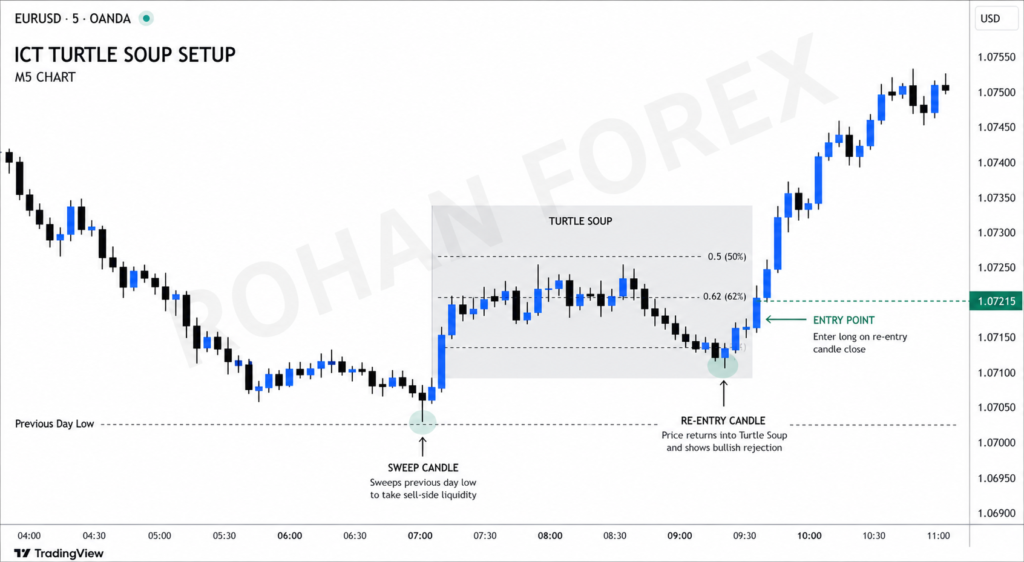
- Re-entry — Price returns back inside the range with a candle that closes on the opposite side of the swept level. This close is the primary confirmation signal that the breakout has failed and the reversal is valid.
- Entry and target — The trade is entered in the direction opposite to the sweep. The initial target is the opposing liquidity pool — the previous day high if a low was swept, or the previous day low if a high was swept.
What Are the Key Components of a Valid Turtle Soup Setup?
A Turtle Soup that lacks any of these components is not a valid setup — it is a breakout with a wick, which is a meaningfully different thing.
- A clean, well-defined key level — Previous day high, previous day low, Asian session high or low, or a clear equal highs or equal lows formation. The level must be obvious enough that retail traders have placed stops at it in significant quantity.
- A confirmed liquidity sweep — Price must move beyond the level, not just touch it. The sweep must be visible on the execution timeframe (M5 or M15).
- A re-entry candle — A candle that closes back inside the range after the sweep. This is non-negotiable. Without this close, there is no confirmation of failure.
- Session timing alignment — The sweep must occur inside a valid Kill Zone window. Sweeps outside these windows have significantly lower reversal probability.
- Opposing liquidity target — There must be a clearly identifiable target on the opposite side of the range. Without a target, there is no trade — only an entry.
What Is a Bullish ICT Turtle Soup Setup?
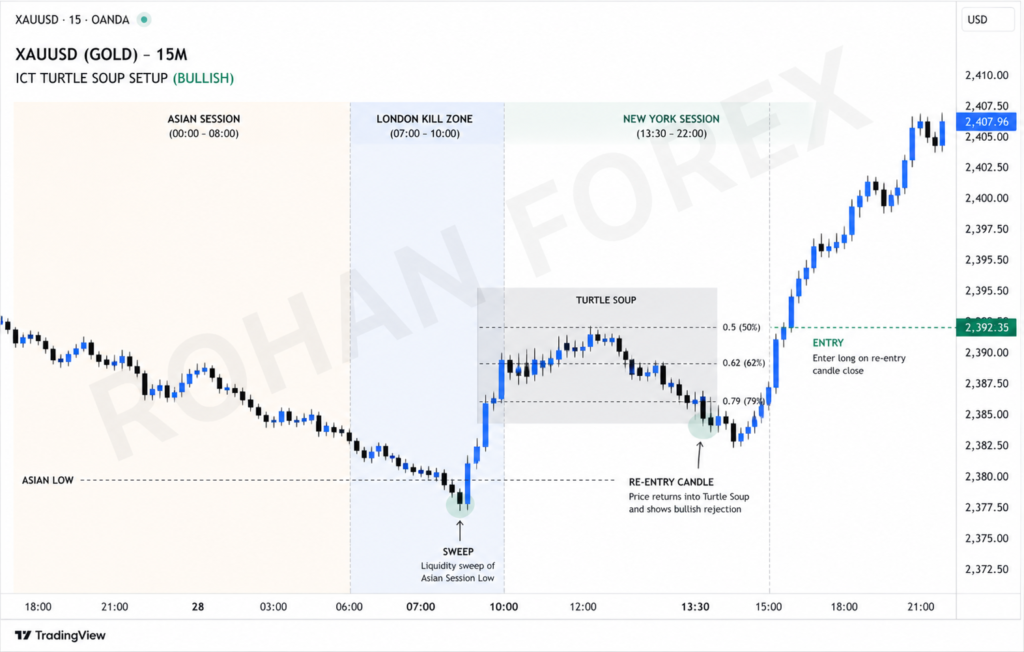
A bullish Turtle Soup forms when price breaks below a key low, sweeps the sell-side liquidity resting beneath it, and then reverses upward back inside the range.
The narrative begins with a bearish-looking move. Price drops below the previous day low or Asian session low with enough force to appear like a genuine breakdown. Short-sellers enter expecting continuation lower. At the same time, the stop losses of traders who were long above that low are triggered. Both groups provide the resting sell-side liquidity that institutional buyers require to accumulate long positions at discounted prices.
Once that pool is consumed, price reverses sharply upward. The short-sellers who entered on the false breakdown are now trapped and must cover, which accelerates the upward move. The bullish Turtle Soup is not an impulsive reaction to a wick — it is an informed entry taken after the failure of the bearish move has been structurally confirmed.
The target is the nearest buy-side liquidity above price — equal highs, the previous day high, or an unfilled fair value gap on the H1 or H4 chart. Some traders use a market structure shift on M5 — specifically a higher high printed after the re-entry — as their precise entry trigger rather than entering immediately on the re-entry candle close.
What Is a Bearish ICT Turtle Soup Setup?
A bearish Turtle Soup forms when price breaks above a key high, collects the buy-side liquidity sitting above it, and then reverses downward sharply back inside the range.
This setup is particularly common during the early New York session, where the market frequently produces an initial push higher — the Judas Swing — before rolling over and seeking lower prices. Traders who buy the breakout above the previous day high interpret the move as bullish continuation. They enter long. Price reverses and they become trapped, their exits adding momentum to the downside move.
The re-entry candle — a close back below the swept high — is the confirmation. The short entry is taken at or near that close, with a stop loss placed above the swept wick, beyond the liquidity pool. The target is the nearest sell-side liquidity below price, typically the previous day low, a clear equal lows formation, or a fair value gap on the H1 chart that has not yet been mitigated.
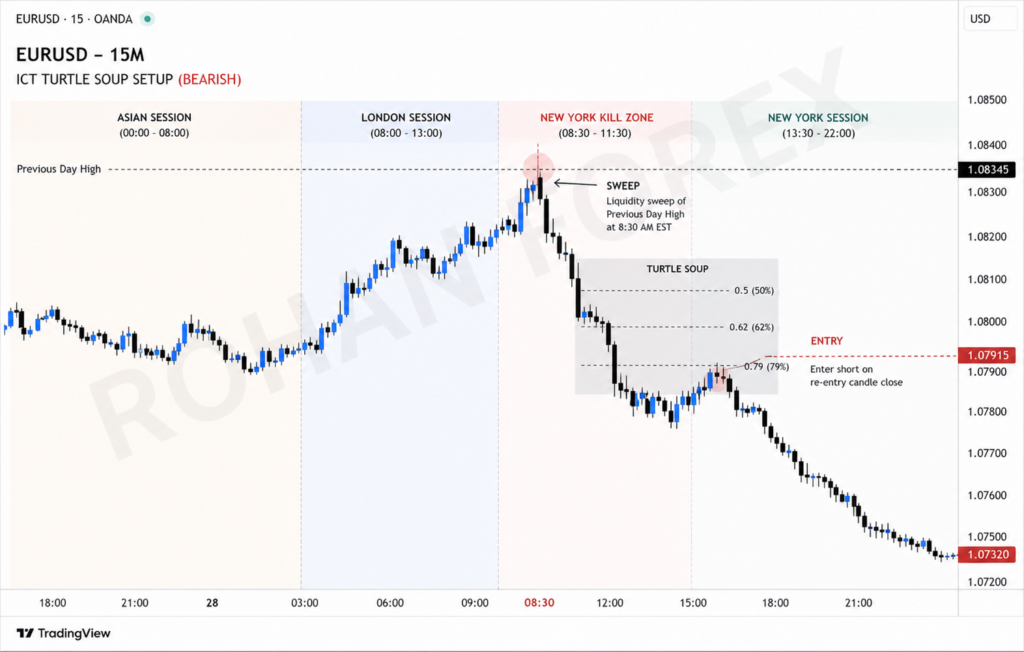
The bearish Turtle Soup reinforces one of the foundational ideas in ICT methodology: buying a break of a well-known high is frequently one of the worst-timed entries a retail trader can make. The high exists to attract buyers and collect their stops, not to confirm bullish direction.
What Is the Role of Liquidity in the Turtle Soup Setup?
Liquidity is not a supporting concept in the Turtle Soup — it is the reason the setup exists at all. Without the concentrated resting orders at key levels, there would be no sweep, and without the sweep, there would be no reversal to trade.
In ICT methodology, liquidity pools form naturally above swing highs and below swing lows because retail risk management conventions are predictable. A trader short from a high places a stop above that high. A trader long from a low places a stop below that low. When enough market participants follow these conventions, the resulting concentration of orders becomes a target for institutional order flow.
Large positions cannot be filled in thin markets without moving price against the intended direction. By engineering a move into a liquidity pool, institutional participants access the resting orders they need to fill at scale. Once the pool is consumed — once the stops are triggered and the breakout traders are positioned — the institutional position is established and price is free to move in the intended direction.
The Turtle Soup is what that intended direction looks like as a trade setup. The sweep is the collection event. The re-entry is the confirmation that collection is complete. The reversal is the institutional position being moved into profit.
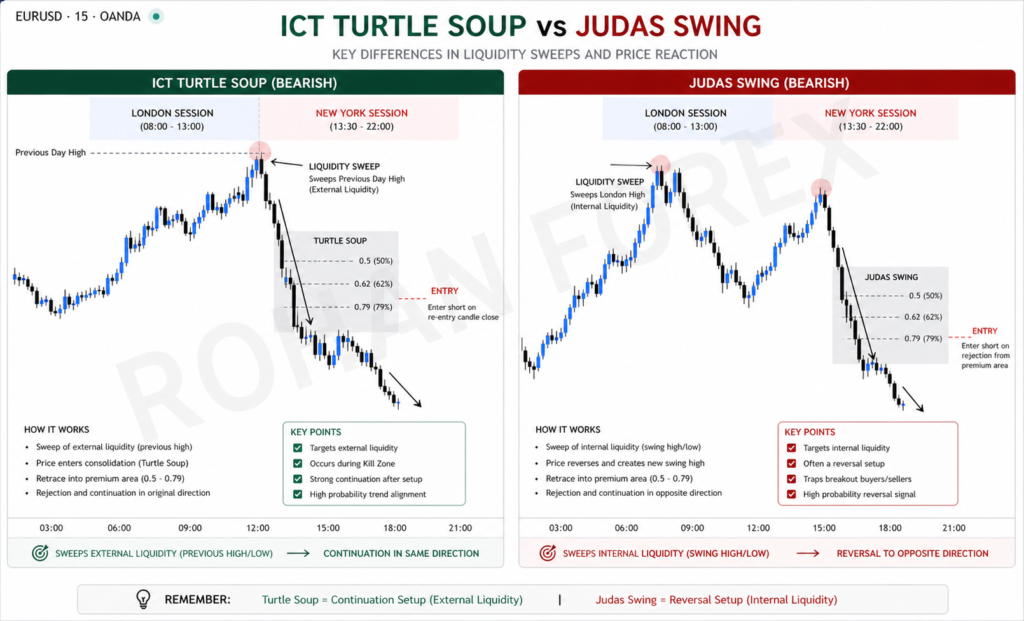
How Is the Turtle Soup Different from the ICT Judas Swing?
Both concepts involve liquidity and reversals, but they operate at different levels of the trading framework and serve different analytical functions.
| Feature | Turtle Soup | Judas Swing |
|---|---|---|
| Type | Specific entry setup | Session-level directional framework |
| Function | Identifies the exact entry point | Identifies which side is being trapped for the session |
| Scope | Single price event | Full session narrative |
| Timing | Kill Zone windows | Session open |
| Entry trigger | Re-entry candle or MSS on M5 | After the false move completes |
The Judas Swing tells you what the market is doing at the session level — which side is being engineered as a trap. The Turtle Soup tells you exactly where and how to enter the reversal that follows. In practice, the highest-quality Turtle Soup setups often occur as the entry mechanism within a Judas Swing sequence. The Judas Swing provides the session bias. The Turtle Soup provides the entry.
How Is the Turtle Soup Different from a Liquidity Grab?
A liquidity grab is a single moment — the sweep of a level and the collection of stop orders. It is a price action event, not a trade setup.
The Turtle Soup is the complete model built around that event. It includes the liquidity grab as its first component, then adds the confirmation structure, the entry logic, and the target definition. The liquidity grab tells you a sweep occurred. The Turtle Soup tells you what to do when that sweep fails to continue.
This distinction matters practically. Many traders observe a wick beyond a key level and enter immediately, treating the wick itself as their signal. This approach lacks the re-entry confirmation that separates a Turtle Soup from a simple reactionary trade. Setups that continue in the direction of the sweep — which happens regularly — result in losses for traders who enter without waiting for price to close back inside the range.
What Are the Most Common Mistakes in Trading the ICT Turtle Soup?
- Entering during the sweep instead of after the re-entry. The sweep looks like momentum. It is designed to look that way. Entering during it means entering in the wrong direction without confirmation.
- Trading without higher timeframe alignment. A bullish Turtle Soup on M15 that runs against a bearish H4 structure has significantly reduced probability. Establish session bias on H1 or H4 before executing on M5 or M15.
- Using unclear or over-visited levels. A level that price has tested three or four times has already depleted much of its liquidity. The Turtle Soup works best at levels that are clean and that have not been recently swept.
- Trading outside Kill Zone windows. The New York lunch hour and the late London session produce choppy, low-volume conditions. Sweeps during these periods often lack the reversal conviction necessary for a clean trade.
- Setting targets at the wrong level. The opposing liquidity is the correct target, not a random resistance or a psychological round number. Using incorrect targets leads to premature exits or missing the full move.
- Ignoring the stop loss placement. The stop loss belongs beyond the wick — above the swept high for a bearish setup, below the swept low for a bullish setup. Any tighter placement risks being stopped out by natural volatility before the reversal plays out.
Which Markets Work Best for the ICT Turtle Soup Setup?
| Market | Suitability | Reason |
|---|---|---|
| EURUSD | Very High | Deep liquidity, clean session structure, predictable PDH/PDL raids |
| GBPUSD | High | Volatile London moves, frequent Asian range sweeps |
| Gold (XAUUSD) | Very High | Wide range, high sensitivity to liquidity engineering, clean Asian range boundaries |
| NAS100 | High | Strong New York open reactions, clear PDH/PDL behavior |
| ES (S&P 500 Futures) | High | Reliable 8:30 AM EST sweep-and-reversal sequences |
| Crypto | Low | Irregular session structure, thin liquidity outside major hours |
Gold and EURUSD are the two most consistent performers for this setup. Both have the institutional participation, session structure, and range behavior that produce textbook Turtle Soup conditions multiple times per week.
Can Beginners Trade the ICT Turtle Soup Setup?
The Turtle Soup is one of the more accessible ICT models for beginners because the rules are observable and specific. There are no indicator thresholds to calibrate, no subjective trend definitions, and no complex multi-step confluences required. The structure is identify the level, wait for the sweep, wait for the re-entry, enter the reversal.
The difficulty is behavioral, not analytical. Watching price break through a key level with conviction and choosing not to react — choosing instead to wait for the failure — is a skill that takes repetition to develop. Most beginners enter during the sweep because the breakout appears to confirm direction. Training that impulse out of your decision-making requires deliberate practice.
A practical approach for beginners: restrict trading to EURUSD or Gold during the London Kill Zone only, execute exclusively on demo for a minimum of 50 documented setups, and log every trade with the level used, the session, the re-entry confirmation type, and the result. That journal will reveal exactly which conditions produce the highest win rate in your own execution, which is more valuable than any generic guideline.
The rule set is simple enough that beginners can apply it consistently. The edge comes from applying it selectively.
Frequently Asked Questions
What timeframe is best for trading the ICT Turtle Soup setup? Use H1 or H4 to identify the key level and determine the higher timeframe directional bias. Drop to M5 or M15 for execution — specifically to identify the sweep, the re-entry candle, and optionally a market structure shift that confirms the reversal has begun. Using a higher timeframe for context and a lower timeframe for entry is standard ICT multi-timeframe methodology and significantly filters out low-quality Turtle Soup attempts.
What is the ICT Turtle Soup setup in simple terms? It is a failed breakout trade. Price breaks a known level, traps traders who follow the breakout, and then reverses sharply in the opposite direction. The trade is taken against the breakout after the failure is confirmed by price closing back inside the range.
Is the ICT Turtle Soup a reversal strategy? Yes. The entire premise is that the breakout is false and price will return and move toward the opposing liquidity pool. The trade direction is always opposite to the initial sweep. A sweep below a low produces a long trade. A sweep above a high produces a short trade.
What confirms a valid Turtle Soup setup? The primary confirmation is a candle that closes back inside the range after the sweep — specifically, a close back above the swept low for a bullish setup or back below the swept high for a bearish setup. A secondary and more precise confirmation is a market structure shift on M5, where price prints a higher high following a bullish sweep or a lower low following a bearish sweep, indicating that short-term delivery has shifted direction.
Does the Turtle Soup setup work in Forex? Yes, particularly in EURUSD and GBPUSD during the London and New York Kill Zones. These pairs have the institutional volume and session structure required for clean sweep-and-reversal sequences. The previous day high and low are the most reliable levels on both pairs, with the London session producing Asian range raids and the New York session producing previous day level raids around 8:30 AM EST.
Is the Turtle Soup the same as a fake breakout? They describe the same price event in general terms, but the Turtle Soup is a defined model with specific rules. A fake breakout simply describes a breakout that did not continue. The Turtle Soup requires a clean key level, a confirmed liquidity sweep, a re-entry candle closing back inside the range, and an identifiable liquidity target on the opposite side. The distinction matters for consistency — vague observations do not produce repeatable edge.
What is the best time to trade the ICT Turtle Soup setup? The London Kill Zone from 2:00 AM to 5:00 AM EST and the New York Kill Zone from 8:00 AM to 11:00 AM EST are the highest-probability windows. Within those, the 8:30 AM EST news spike during the New York session produces some of the cleanest setups of any session, as the volatility spike executes the sweep rapidly and the reversal follows with strong momentum. The 10:00 AM to 11:00 AM Silver Bullet window is a secondary opportunity for setups that did not develop cleanly earlier in the session.
Can the Turtle Soup setup fail? Yes. If price sweeps a level, briefly re-enters the range, and then continues in the original direction of the breakout, the setup fails. This is why the stop loss is placed beyond the swept wick — above the high that was swept for a bearish setup, or below the low that was swept for a bullish setup. Not every setup completes. Selectivity and consistent stop placement determine long-term profitability, not individual trade accuracy.
Does the Turtle Soup work on Gold (XAUUSD)? Gold is one of the most consistent markets for this setup. Its wide daily range, high sensitivity to liquidity engineering, and well-defined Asian session boundaries make it well-suited for Turtle Soup conditions during the London Kill Zone. Asian session high and low sweeps on Gold during 2:00 AM to 5:00 AM EST are among the most reliable configurations of this setup across any market.
How is the Turtle Soup related to stop hunts? A stop hunt is the mechanism behind the Turtle Soup — the deliberate move into a level to collect resting stop orders. The Turtle Soup is the structured trade that forms around that event. Every valid Turtle Soup begins with a stop hunt. The distinction is that stop hunt describes the event; Turtle Soup describes the complete setup including confirmation, entry, and target logic that follows from it.

Muhammad Rohan
Rohan is an 3+ Years Experience in Smart Money Concepts (SMC) Specialized in liquidity, market structure & institutional order flow Focused on discipline, risk management & consistent profitability

Fouzia Sana
Fouzia Sana is a forex trader and market educator specializing in Smart Money Concepts (SMC). With a strong focus on liquidity analysis, market structure, and institutional order flow, she simplifies advanced trading concepts into practical, easy-to-understand strategies. Her work emphasizes disciplined trading, risk management, and consistency in execution.