
Table of Contents
- What Is the ICT True Weekly Opening Gap?
- Why Does the ICT True Weekly Opening Gap Form?
- When Exactly Does the ICT True Weekly Opening Gap Occur?
- How Do You Identify a Valid ICT True Weekly Opening Gap?
- How to Mark It on a Chart
- How Does the ICT True Weekly Opening Gap Influence Weekly Bias?
- How Does Price React to the ICT Weekly Opening Gap?
- How to Trade the ICT True Weekly Opening Gap?Complete Trading Strategy
- ICT True Weekly Opening Gap vs. Daily True Opening Gap (TOG)
- ICT True Weekly Opening Gap vs. Fair Value Gap (FVG)
- Which Markets Are Best Suited for ICT Weekly Opening Gap Analysis?
- Does the ICT True Weekly Opening Gap Always Get Filled?
- Most Common Mistakes When Trading the ICT True Weekly Opening Gap
- Recommended Timeframes for ICT Weekly Opening Gap Analysis
- Can Beginners Use the ICT True Weekly Opening Gap?
- What is the ICT True Weekly Opening Gap in simple terms?
- Does the weekly gap always get filled?
- What day is best for trading the weekly gap?
- Is the weekly gap better than the daily True Opening Gap?
- Can the ICT weekly gap fail?
- Which instruments produce the best weekly gaps?
- How is the weekly gap different from a Fair Value Gap?
- Do indices work for weekly gap analysis?
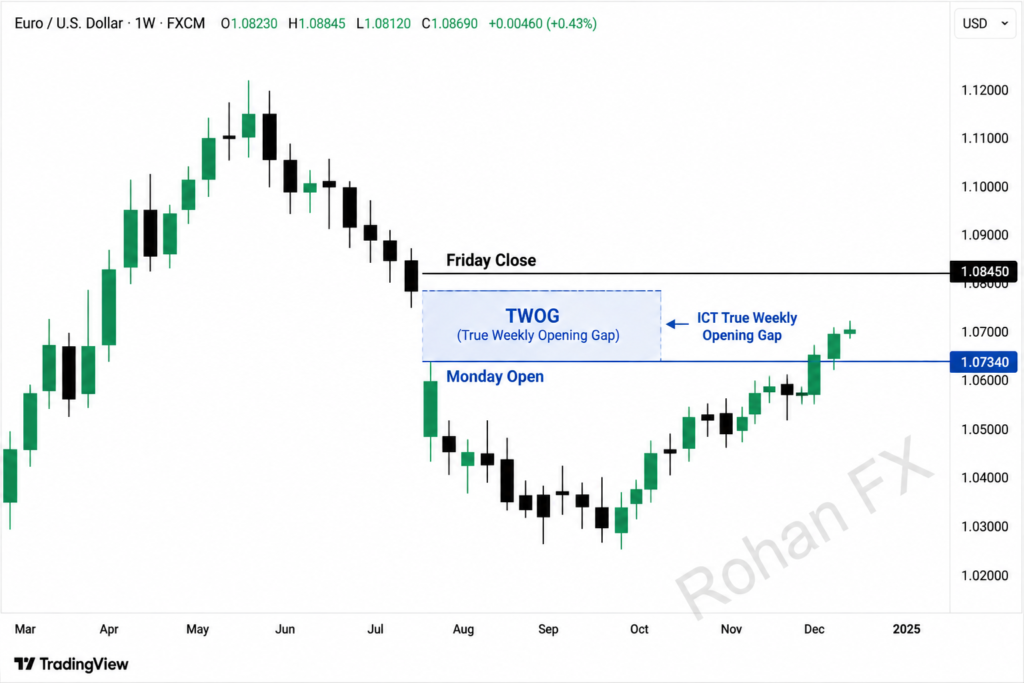
The ICT True Weekly Opening Gap (TWOG) is the price gap that forms between Friday’s closing price and Monday’s opening price in Forex and related markets. In Smart Money Concepts, it signals how institutions have repriced the market over the weekend and is used to establish weekly bias, identify key reaction levels, and frame directional trade planning for the week ahead.
What Is the ICT True Weekly Opening Gap?
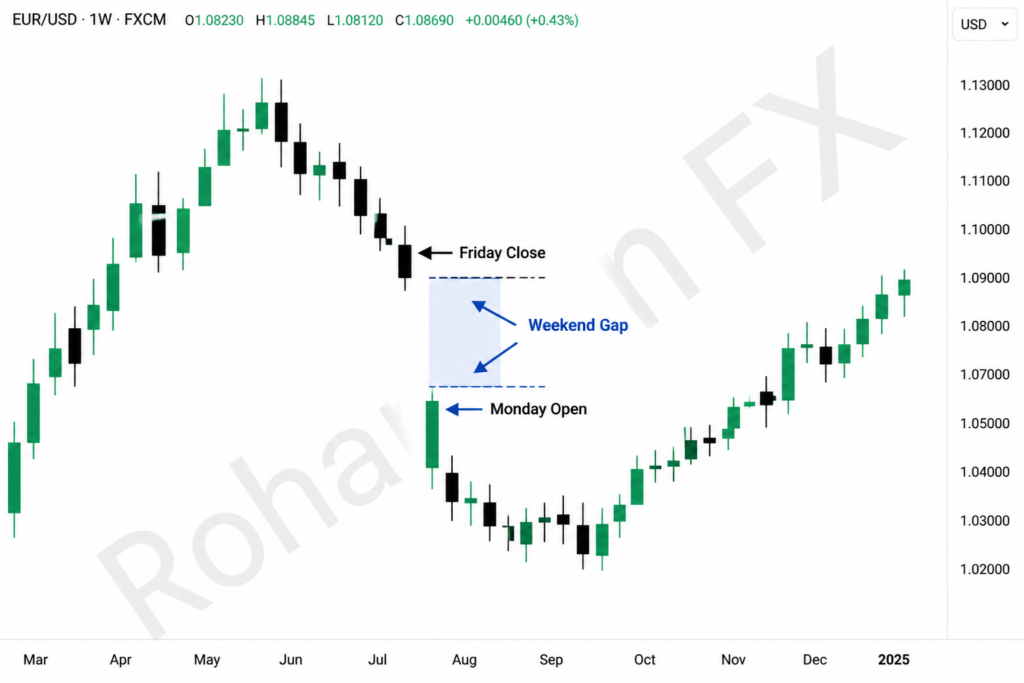
The ICT True Weekly Opening Gap is a core concept in Michael J. Huddleston’s Inner Circle Trader methodology. It refers to the visible gap between the last traded price on Friday and the first available price when markets reopen on Sunday evening (New York time).
This is not simply a visual anomaly on the chart. In Smart Money Concepts, the weekly gap is treated as evidence of institutional repricing — a reflection of how large participants have repositioned themselves during the weekend, when retail traders are absent but information continues to flow.
Understanding it correctly separates traders who react to price from those who can frame expectations before the week begins.
Why Does the ICT True Weekly Opening Gap Form?
Markets close over the weekend, but institutional decision-making does not. When trading resumes on Sunday evening, price must adjust to reflect everything that happened while markets were offline.
The primary drivers behind weekly gap formation include:
- Institutional repositioning: Large funds and banks adjust exposure based on macro outlook and risk models
- Economic and geopolitical events: News released over the weekend — central bank communications, geopolitical developments, or data revisions — shifts collective sentiment
- Accumulated liquidity imbalances: Stop orders, limit orders, and pending positions build up during the weekend closure, creating directional pressure at the open
Rather than treating this repricing as noise, ICT traders treat it as a clue about where the market is already leaning before price action begins.
When Exactly Does the ICT True Weekly Opening Gap Occur?
The timing is consistent across the Forex market each week.
| Event | Time (New York) | Role |
| Friday Close | ~17:00 ET | Final traded price of the week |
| Sunday Open (Forex) | ~17:00 ET | Gap appears here |
| Monday Session | Active London/NY hours | Key reaction window |
| Tuesday Session | Active hours | Continuation or resolution |
The gap forms at the seam between these two sessions. For most major Forex pairs — EURUSD, GBPUSD, XAUUSD — this gap is visible and tradable.
The most important reactions typically occur on Monday and Tuesday. How price behaves in those two sessions often defines the directional tone for the remainder of the week.
How Do You Identify a Valid ICT True Weekly Opening Gap?
Not every visible gap qualifies. ICT methodology distinguishes between meaningful gaps and insignificant price differences.
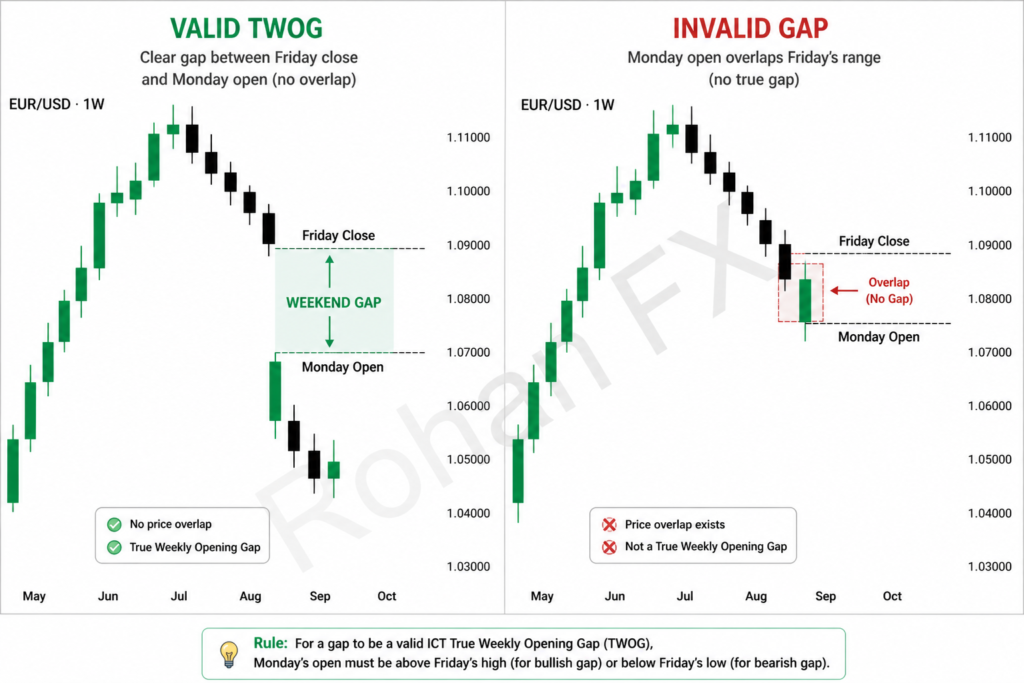
A valid TWOG must meet all of these criteria:
- There is a clear, visible price difference between Friday’s closing candle and Monday’s opening candle
- There is no overlap between the two candles — the bodies do not touch
- The gap forms in a liquid instrument with consistent institutional participation (major Forex pairs, Gold)
- The gap is large enough to represent meaningful repricing, not a few pips of spread noise
How to Mark It on a Chart
- Identify the final closed candle of Friday’s session
- Identify the first candle of the new week (Sunday/Monday open)
- Highlight the empty space between the high/low of those two candles
- Label this zone as your TWOG reference area for the week
This marked zone becomes an active reference point throughout the trading week — it is not something you observe once and discard.
How Does the ICT True Weekly Opening Gap Influence Weekly Bias?
Establishing weekly bias is one of the most practical uses of the TWOG. The direction of the gap provides an early read on how the market has been repositioned.
- A bullish gap (Monday opens above Friday’s close) may indicate upward institutional intent
- A bearish gap (Monday opens below Friday’s close) may indicate downward pressure or distribution
However, the gap alone is not sufficient. It must be confirmed against higher timeframe context, including:
- Weekly and daily structure (higher highs/higher lows or the opposite)
- Proximity to key liquidity levels (buy-side or sell-side liquidity pools)
- Premium and discount zones relative to the broader price range
When the gap direction aligns with the higher timeframe narrative, it becomes a high-confidence weekly bias indicator.
How Does Price React to the ICT Weekly Opening Gap?
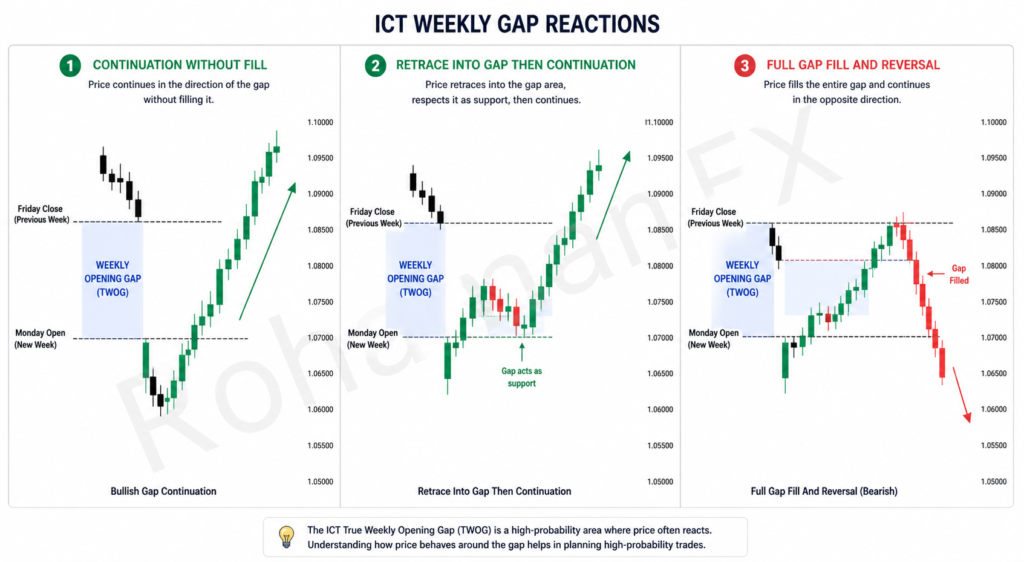
Once identified, the gap zone acts as a structural reference for the week. Price does not move randomly around it. ICT traders observe three primary behavioral patterns:
1. Continuation Price opens with a gap and continues in the same direction without returning to fill it. This occurs in strong trending conditions when institutional conviction is high.
2. Retracement Into the Gap Price revisits the gap zone early in the week — often during the London or early New York session — before resuming in the direction of bias. This “gap fill and go” behavior is one of the most tradeable setups within the TWOG framework.
3. Full Fill and Reversal Price fills the gap entirely and then reverses, suggesting the initial direction was a trap or that bias has shifted. This is less common but important to monitor.
The gap zone in bullish scenarios may act as support on a retracement. In bearish scenarios, it may act as resistance on a bounce.
How to Trade the ICT True Weekly Opening Gap?Complete Trading Strategy
The TWOG is not a standalone entry trigger — it is a planning framework. Follow this structured process each week:
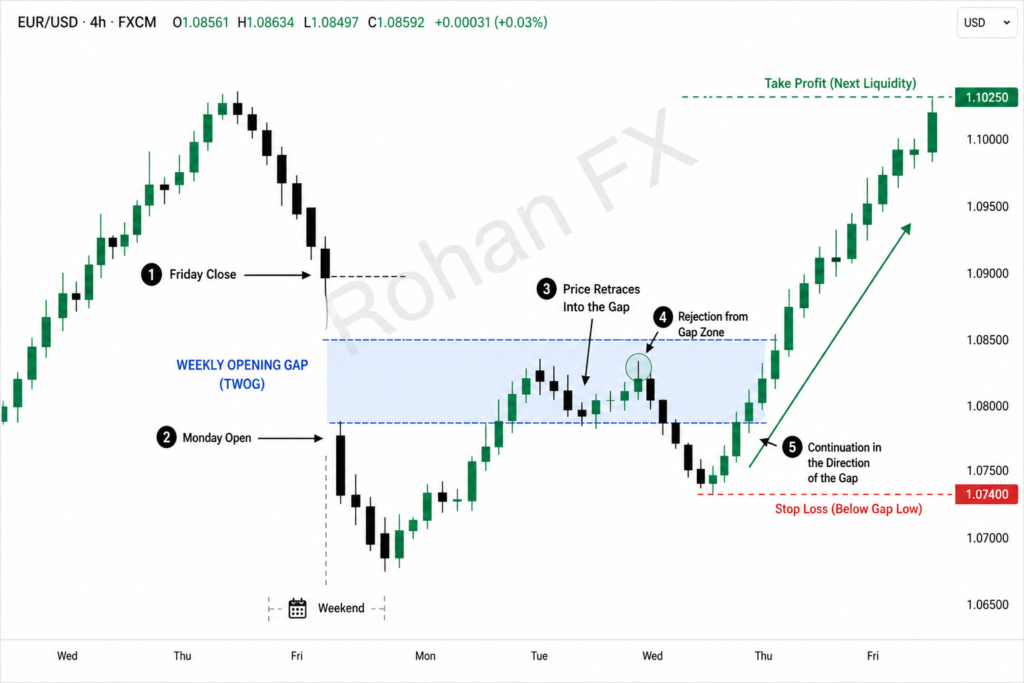
- Mark Friday’s closing price at the end of the weekly candle
- Identify Monday’s opening price when markets reopen
- Highlight the gap zone between these two price levels
- Establish weekly bias using the daily and weekly chart structure
- Confirm bias alignment — does the gap direction match higher timeframe context?
- Monitor early-week price action (Monday London, Monday NY, Tuesday sessions)
- Wait for confirmation — a market structure shift, order block reaction, or clear rejection within the gap zone
- Execute in alignment with bias, targeting nearby liquidity levels such as previous weekly highs or lows
Patience is critical. The most common mistake is entering at the gap open without any confirmation — the gap is the map, not the trigger.
ICT True Weekly Opening Gap vs. Daily True Opening Gap (TOG)
These are related but distinct concepts that serve different functions.
| Feature | Weekly Opening Gap (TWOG) | Daily True Opening Gap (TOG) |
| Timeframe | Weekly | Intraday |
| Formation | Weekend session transition | Daily session open |
| Primary Use | Strategic weekly bias | Tactical intraday context |
| Typical Impact | Broad directional framing | Short-term price behavior |
| Confirmation Needed | Higher timeframe structure | Intraday order flow |
The TWOG provides macro context. The daily TOG refines intraday decisions within that context. Used together, they create a layered approach to market analysis that aligns strategic planning with tactical execution.
ICT True Weekly Opening Gap vs. Fair Value Gap (FVG)
Both concepts involve price imbalance, but they differ significantly in structure and application.
| Feature | Weekly Opening Gap | Fair Value Gap (FVG) |
| Formation | Between Friday close and Monday open | Within continuous price action (3-candle pattern) |
| Structure | Gap between two separate sessions | Imbalance created by impulsive move |
| Primary Role | Bias and weekly context | Entry refinement and precision |
| Timeframe Context | Strategic (weekly) | Tactical (H1, M15, M5) |
The weekly gap operates at a higher conceptual level. FVGs are tools for precision entries once bias has been established using concepts like the TWOG.
Which Markets Are Best Suited for ICT Weekly Opening Gap Analysis?
The TWOG concept is most applicable in markets that cleanly reopen after the weekend.
| Market | Suitability | Notes |
| Major Forex Pairs (EURUSD, GBPUSD) | High | Most consistent gap formation |
| Gold (XAUUSD) | High | Frequently produces tradeable gaps |
| US Indices (NQ, ES) | Moderate | Futures reopen Sunday, but gap dynamics differ |
| Crypto | Low | Markets don’t close, no true weekly gap forms |
Forex is the primary market for TWOG analysis because it follows a predictable open/close cycle that produces consistent, institutionally meaningful gaps week after week.
Does the ICT True Weekly Opening Gap Always Get Filled?
No — and assuming otherwise is one of the most costly errors traders make with this concept.
Price may:
- Partially fill the gap before reversing
- Fully fill the gap and then continue in the original direction
- Fully fill the gap and reverse completely
- Never revisit the gap at all in strong trending conditions
In strong institutional trends, gaps frequently remain open for extended periods as price continues toward distant liquidity targets. The gap is a reference level, not a mandate that price must return.
The correct question is not will this gap fill but rather what does this gap tell me about where price may go this week.
Most Common Mistakes When Trading the ICT True Weekly Opening Gap
Awareness of these errors can prevent significant losses:
- Trading the gap without confirmation — entering immediately at the open without waiting for price reaction
- Assuming all gaps must fill — leading to countertrend trades with poor reasoning
- Ignoring higher timeframe context — treating the gap as an isolated signal
- Overtrading early in the week — chasing every Monday move before structure develops
- Using unclear or minimal gaps — marking gaps that are too small to carry institutional significance
- Confusing direction — mistaking a bearish gap for a bullish opportunity because price moves up initially (Judas Swing behavior)
Recommended Timeframes for ICT Weekly Opening Gap Analysis
Multi-timeframe analysis is essential for using this concept correctly.
For bias and context:
- Weekly chart — overall trend direction
- Daily chart — recent structure, order blocks, liquidity levels
For reaction and entry refinement:
- 1-Hour chart — observe gap zone behavior and structure shifts
- 15-Minute chart — precision entry timing, FVGs, and order block reactions
This layered approach ensures that your trade decisions are aligned from the macro level down to the execution level.
Can Beginners Use the ICT True Weekly Opening Gap?
Yes, but the appropriate starting point is observation, not execution.
A structured learning approach for beginners:
- Mark the weekly gap every Sunday without placing any trades
- Journal how price reacts to the gap each week — does it fill, ignore, or continue?
- Note which higher timeframe conditions preceded each outcome
- After 8–12 weeks of observation, begin paper trading reactions to the gap
- Only transition to live trading once consistent patterns are recognized
This builds genuine pattern recognition over time, which is far more valuable than rushing into trades based on incomplete understanding.
Key Takeaways
- The ICT True Weekly Opening Gap is the price difference between Friday’s close and Monday’s open, reflecting weekend institutional repricing
- It is a bias tool, not a standalone entry signal
- Valid gaps require a clear separation with no candle overlap, in liquid instruments
- Price may fill the gap, partially fill it, or never return — outcome depends on market context
- Monday and Tuesday are the most important sessions for observing gap behavior
- The TWOG must always be interpreted alongside higher timeframe structure and liquidity analysis
- Forex pairs (EURUSD, GBPUSD) and Gold (XAUUSD) are the most suitable markets
- Beginners should spend weeks in observation mode before executing trades based on this concept
Frequently Asked Questions
What is the ICT True Weekly Opening Gap in simple terms?
It is the price gap between Friday’s closing price and Monday’s opening price, showing how the market was repriced over the weekend before trading resumed.
Does the weekly gap always get filled?
No. In trending markets, gaps often remain open as price moves toward liquidity targets without returning to the gap zone.
What day is best for trading the weekly gap?
Monday and Tuesday are the most important sessions. Gap reactions that define weekly tone most often occur within these two days.
Is the weekly gap better than the daily True Opening Gap?
They serve different purposes. The weekly gap provides strategic weekly bias. The daily TOG refines intraday decisions. Both are used together in ICT methodology.
Can the ICT weekly gap fail?
Yes. Failure occurs when the underlying bias is incorrect, when external events override institutional positioning, or when price action clearly invalidates the expected narrative. No concept works in isolation.
Which instruments produce the best weekly gaps?
EURUSD, GBPUSD, and XAUUSD (Gold) are consistently the most reliable instruments for TWOG analysis due to their liquidity and clear weekend open structure.
How is the weekly gap different from a Fair Value Gap?
A Fair Value Gap forms within continuous price action as a three-candle imbalance pattern. The TWOG forms between two separate trading sessions (Friday close to Monday open) and is used for bias, not entries.
Do indices work for weekly gap analysis?
Moderately. Equity index futures (NQ, ES) do reopen on Sunday, but the gap dynamics and institutional behavior differ from Forex. Most ICT traders prioritize Forex for this concept.

Muhammad Rohan
Rohan is an 3+ Years Experience in Smart Money Concepts (SMC) Specialized in liquidity, market structure & institutional order flow Focused on discipline, risk management & consistent profitability

Fouzia Sana
Fouzia Sana is a forex trader and market educator specializing in Smart Money Concepts (SMC). With a strong focus on liquidity analysis, market structure, and institutional order flow, she simplifies advanced trading concepts into practical, easy-to-understand strategies. Her work emphasizes disciplined trading, risk management, and consistency in execution.