The ICT Silver Bullet is a time-based algorithmic trading strategy developed by Michael J. Huddleston. It is not just a chart pattern. It is a programmed price delivery window where the algorithm seeks liquidity and reprices toward fair value within a defined 60-minute session.
What is the Core Logic Behind the ICT Silver Bullet?
The ICT Silver Bullet is built on the relationship between Time and Price. The algorithm does not move price randomly — it runs on a schedule. During a Silver Bullet window, the market targets buy-side liquidity (BSL) above swing highs or sell-side liquidity (SSL) below swing lows. Once that liquidity is swept, price displaces sharply in the opposite direction, creating a Fair Value Gap (FVG) in the process.
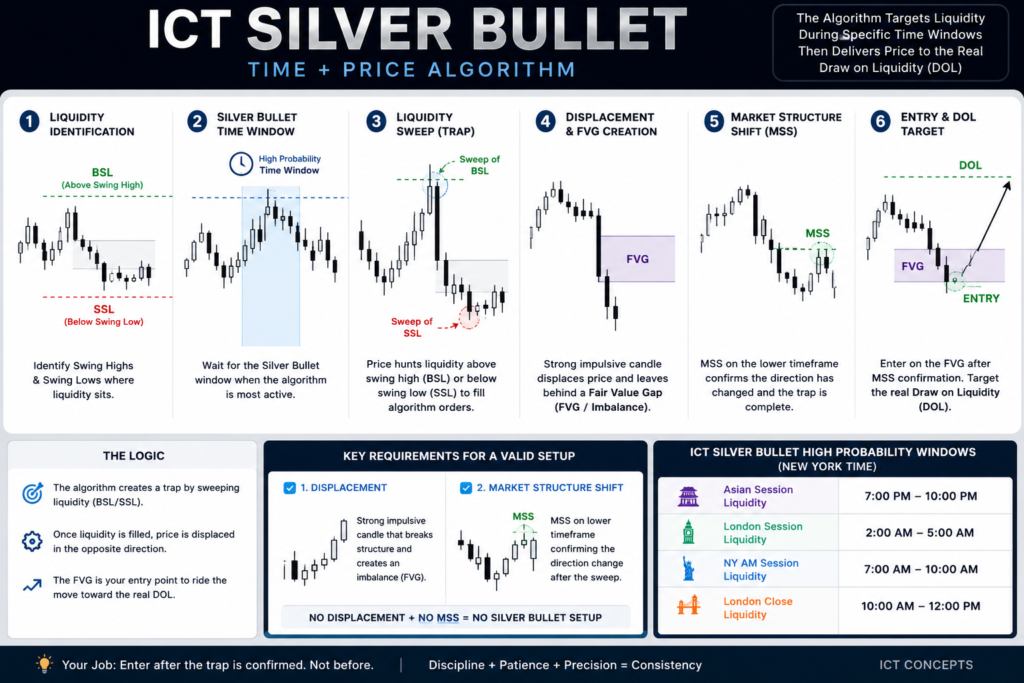
That FVG becomes your entry point. The logic is simple: the algorithm engineered a trap, filled its orders, and is now delivering price toward the real draw on liquidity (DOL). Your job is to enter after the trap is confirmed, not before.
Two things must happen for the setup to be valid. First, a displacement — a strong, impulsive candle that breaks market structure and leaves behind an imbalance. Second, a Market Structure Shift (MSS) on the lower timeframe confirming the direction has changed. Without both, you do not have a Silver Bullet setup. You have noise.
What are the Official ICT Silver Bullet Time Windows?
The ICT Silver Bullet consists of three specific 60-minute windows across the London and New York sessions.
| Session | EST Window | PKT Window | GMT Window | Typical Characteristic |
|---|---|---|---|---|
| London Silver Bullet | 3:00 AM – 4:00 AM | 1:00 PM – 2:00 PM | 8:00 AM – 9:00 AM | Sweeps Asian session highs or lows, sets London direction |
| NY AM Silver Bullet | 10:00 AM – 11:00 AM | 8:00 PM – 9:00 PM | 3:00 PM – 4:00 PM | Highest volume window, clearest MSS and FVG setups |
| NY PM Silver Bullet | 2:00 PM – 3:00 PM | 12:00 AM – 1:00 AM | 7:00 PM – 8:00 PM | Repositions price before market close, overlaps 2:30 PM Macro |
Note: PKT is UTC+5. During US Daylight Saving Time (March to November), EST becomes EDT (UTC-4), which shifts PKT times one hour earlier. For example, the NY AM window becomes 7:00 PM PKT instead of 8:00 PM PKT during summer months.
ICT Silver Bullet Complete Trading Strategy
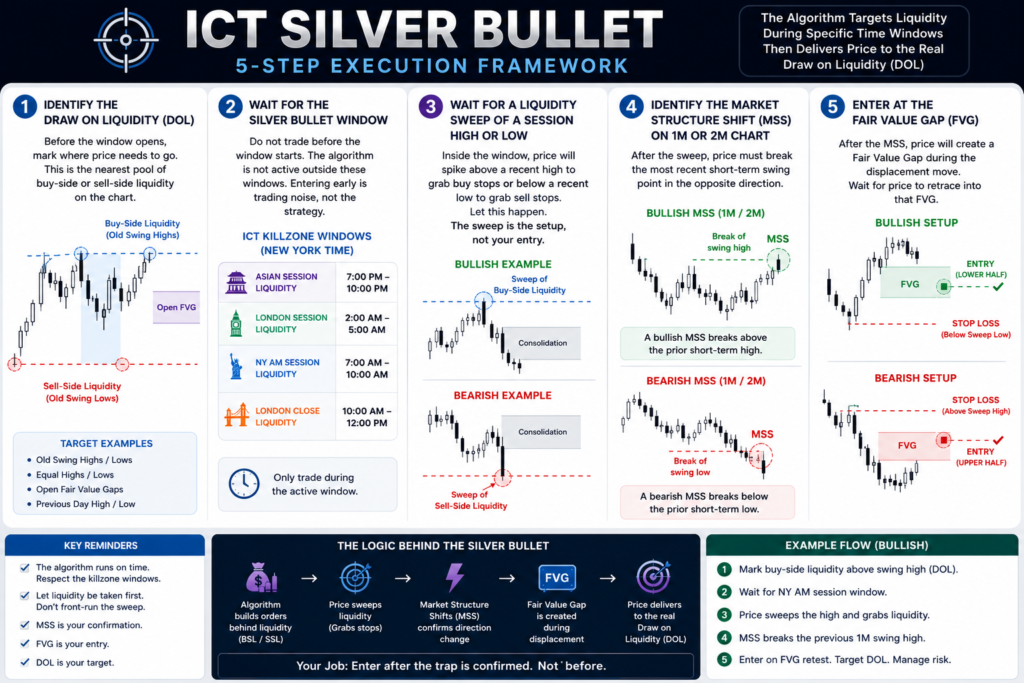
- Identify the Draw on Liquidity (DOL) — Before the window opens, mark where price needs to go. This is the nearest pool of buy-side or sell-side liquidity on the chart. Old swing highs, equal highs, or open Fair Value Gaps are your targets.
- Wait for the Silver Bullet window to open — Do not trade before the window starts. The algorithm is not active outside these windows. Entering early is trading noise, not the strategy.
- Wait for a liquidity sweep of a session high or low — Inside the window, price will spike above a recent high to grab buy stops or below a recent low to grab sell stops. Let this happen. The sweep is the setup, not your entry.
- Identify the Market Structure Shift (MSS) on the 1-minute or 2-minute chart — After the sweep, price must break the most recent short-term swing point in the opposite direction. A bullish MSS breaks above the prior short-term high. A bearish MSS breaks below the prior short-term low. This is your confirmation.
- Enter at the Fair Value Gap — After the MSS, price will create a Fair Value Gap during the displacement move. Wait for price to retrace into that FVG. Enter in the lower half of the gap for bullish trades and the upper half for bearish trades. Place your stop loss beyond the sweep high or low.
ICT Silver Bullet Trade Setup BUllish & Bearish Example
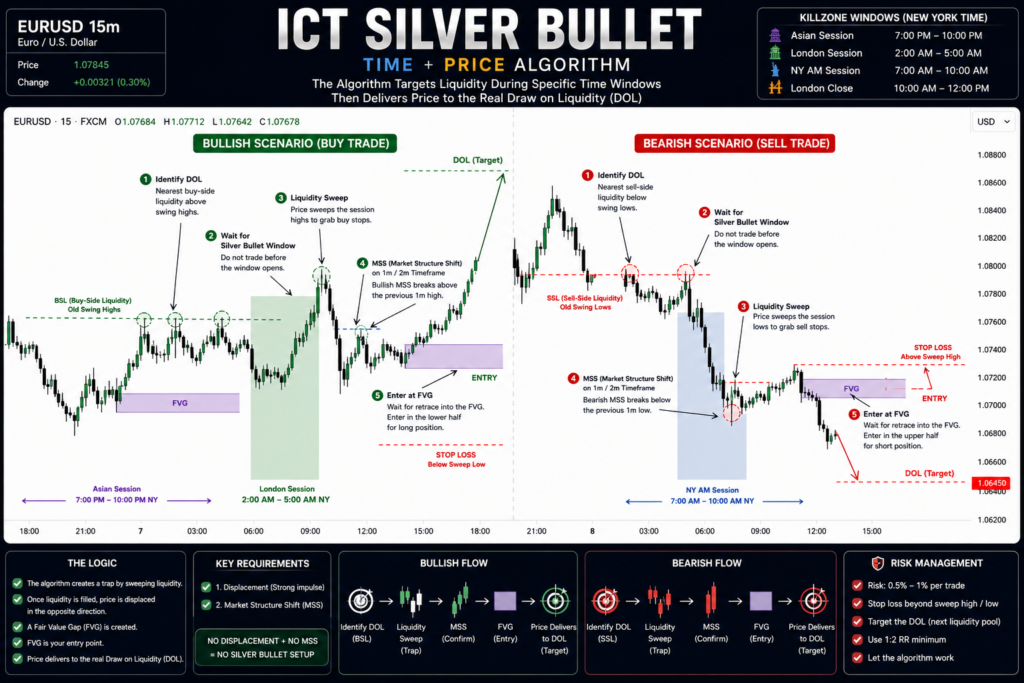
Bullish Setup (Buy Trade)
Price sweeps sell-side liquidity below recent lows during the Silver Bullet window, trapping short sellers before reversing aggressively upward. A bullish Market Structure Shift (MSS) confirms the direction change, and the Fair Value Gap (FVG) created during displacement becomes the optimal entry zone targeting buy-side liquidity.
Bearish Setup (Sell Trade)
Price raids buy-side liquidity above recent highs during the Silver Bullet window, triggering breakout traders before reversing sharply downward. A bearish Market Structure Shift (MSS) confirms weakness, and traders enter from the Fair Value Gap (FVG) retracement targeting sell-side liquidity below the lows.
How Does ICT Silver Bullet Differ from ICT Kill Zones?
Kill Zones are broad 2 to 4 hour session windows that tell you which session is active — London, New York, or Asia. The Silver Bullet is a precise 60-minute pulse nested inside those sessions where the algorithm performs a specific sequence: sweep, shift, and deliver.
Think of Kill Zones as the entire shift at work and the Silver Bullet as the one specific hour in that shift where the most important meeting happens. You still need the Kill Zone context, but the Silver Bullet is where the highest-probability trade occurs.
- Kill Zone: 2 to 4 hour broad session window
- Silver Bullet: 60-minute precision window inside the Kill Zone
- Kill Zone: Sets the session tone and direction
- Silver Bullet: Executes the specific sweep-and-deliver sequence
- Kill Zone: Multiple possible setups, more noise
- Silver Bullet: One clean setup per window, lower screen time
Is the ICT Silver Bullet Strategy Profitable for Beginners?
The ICT Silver Bullet is one of the more beginner-friendly ICT strategies because it limits you to one hour of focused trading per session. Most traders who struggle do so because they overtrade. The Silver Bullet removes that problem by design — if the window closes without a valid setup, you simply do not trade.
Pros
- Trades only one hour per session, reducing decision fatigue
- Clear rules for entry, stop, and target — no guessing
- Applies to Forex, Futures, and Indices
- Works on low capital accounts with proper risk management
- The MSS and FVG rules eliminate subjective entries
Cons
- Requires patience — some days produce no valid setup.
- The 3:00 AM EST London window is difficult for traders in US time zones.
- Beginners may confuse a minor pullback with a genuine MSS.
- News events like NFP can invalidate the setup entirely.
Can you trade the Silver Bullet on a phone? Yes, you can monitor the window and execute on a mobile platform. However, identifying FVGs, marking liquidity levels, and reading the MSS accurately is significantly easier on a desktop with multiple chart windows open. Mobile is a backup, not the primary tool.
What is the ICT Silver Bullet Time in Pakistan (PKT)?
For traders in Pakistan, PKT is UTC+5 and does not observe Daylight Saving Time. The US does observe DST, which creates a shift in the conversion depending on the time of year.
During US Standard Time (November to March) — EST is UTC-5, making the difference 10 hours.
- London Silver Bullet: 1:00 PM – 2:00 PM PKT
- NY AM Silver Bullet: 8:00 PM – 9:00 PM PKT
- NY PM Silver Bullet: 12:00 AM – 1:00 AM PKT (next day)
During US Daylight Saving Time (March to November) — EDT is UTC-4, making the difference 9 hours.
- London Silver Bullet: 12:00 PM – 1:00 PM PKT
- NY AM Silver Bullet: 7:00 PM – 8:00 PM PKT
- NY PM Silver Bullet: 11:00 PM – 12:00 AM PKT
The NY AM Silver Bullet at 7:00 PM to 9:00 PM PKT is the most practical window for Pakistani traders. It falls in the evening, allows for normal daytime schedules, and is the highest-volume Silver Bullet window of the day.