
Table of Contents
- What is ICT Macro Time?
- What are the Key Characteristics of ICT Macro Time?
- How is ICT Macro Time Different from ICT Kill Zone Time?
- What is ICT Macro Time for Forex, Futures, and Indices?
- What Time is London Macro?
- What Time is ICT London Lunch?
- What Time is ICT New York Macro?
- What Time is ICT Asian Macro?
- What Time is the Macro Time for Market Close?
- How To Trade ICT Macro Time-Complete Trading Strategy
- Frequently Asked Questions
- What exactly is a Macro in ICT trading?
- Do ICT Macros work on all currency pairs and instruments?
- Can I enter a trade at the start of a Macro window?
- What is the most important Macro for New York session traders?
- Is the 2:30 PM Macro the same as the Silver Bullet strategy?
The market does not move randomly. Behind every price swing is a timing mechanism — and ICT Macro Time is one of the most precise tools in the Inner Circle Trader methodology for understanding exactly when that mechanism fires. A Macro is a specific 20-minute window during the trading day when the algorithm is programmed to seek liquidity or reprice price toward fair value. These windows repeat every single day, across Forex pairs, Futures contracts, and major Indices. Once you learn them, you stop guessing and start reading the market like a scheduled event.
What is ICT Macro Time?
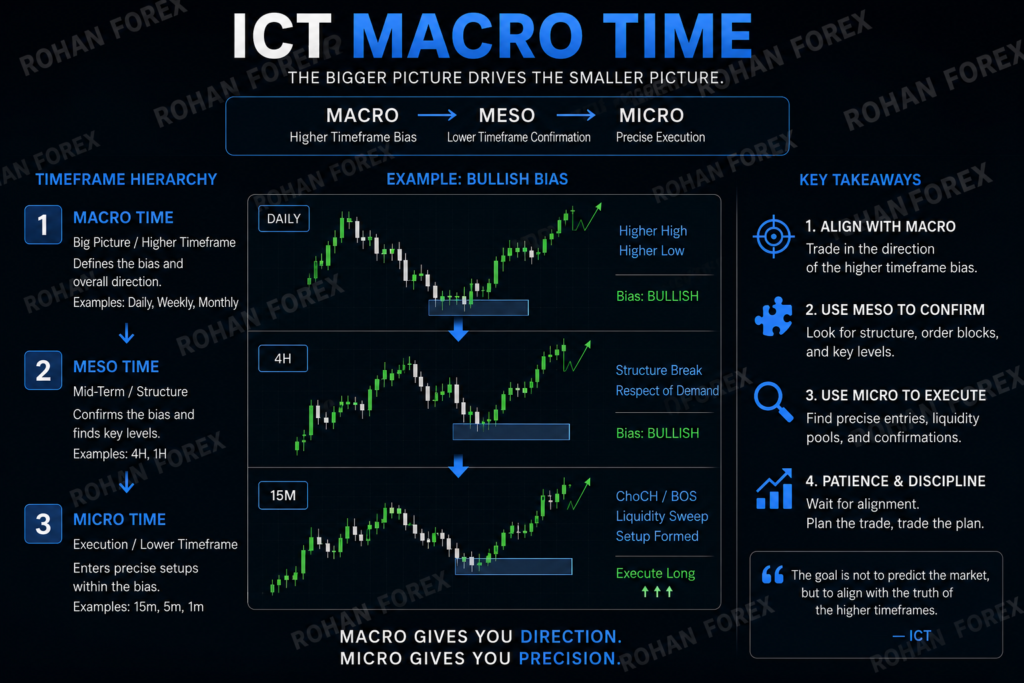
ICT Macro Time refers to high-probability 20-minute execution windows built into the market’s algorithmic price delivery system. The core idea from Michael Huddleston’s ICT concepts is that Time and Price work together. Price does not just move — it moves at specific times for specific reasons. During a Macro window, the algorithm enters what ICT calls a “manual” or “automated” delivery phase. This means the market is actively seeking liquidity above old highs or below old lows, or it is repricing toward an inefficiency like a Fair Value Gap (FVG) or an Order Block. Understanding Macros means you are no longer reactive to price — you are anticipating when the move is scheduled to happen.
What are the Key Characteristics of ICT Macro Time?
Two things consistently happen inside Macro windows:
- Liquidity sweeps and market displacement.
- Liquidity Sweep and Engineered Liquidity
The algorithm uses these 20-minute windows to raid stop-loss clusters sitting above swing highs or below swing lows. This is called engineered liquidity — the market is designed to lure retail traders into breakout entries, then reverse sharply. Inside a Macro, you will often see a quick spike that clears buy stops or sell stops before the real direction is shown. This is not random. It is the algorithm collecting orders to fuel the next move.
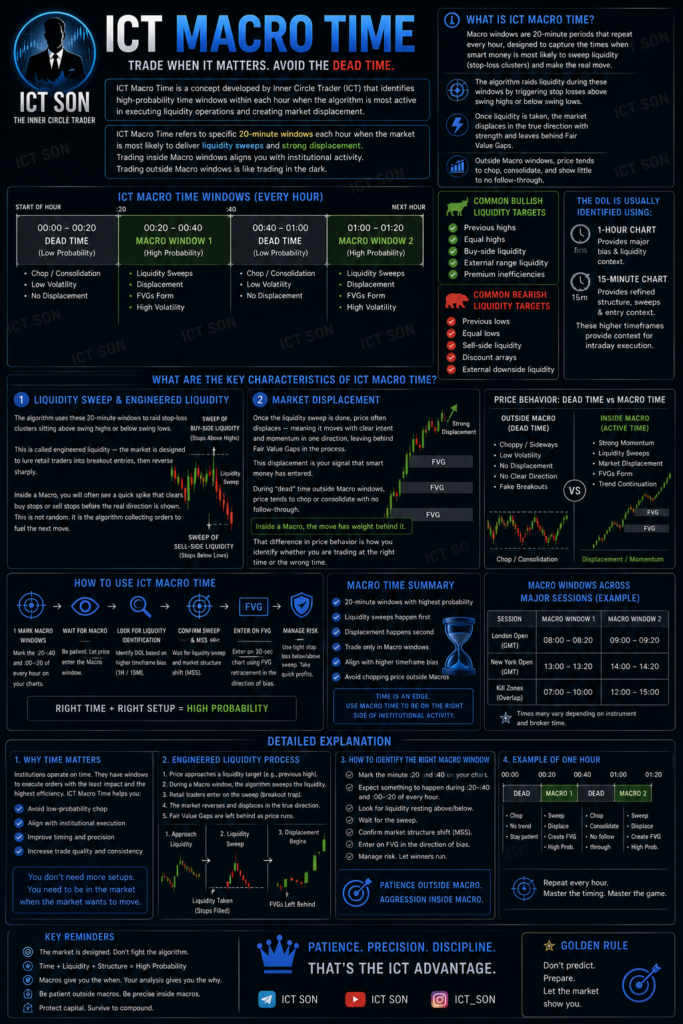
Market Displacement
Once the liquidity sweep is done, price often displaces — meaning it moves with clear intent and momentum in one direction, leaving behind Fair Value Gaps in the process. This displacement is your signal that smart money has entered. During “dead” time outside Macro windows, price tends to chop or consolidate with no follow-through. Inside a Macro, the move has weight behind it. That difference in price behavior is how you identify whether you are trading at the right time or the wrong time.
How is ICT Macro Time Different from ICT Kill Zone Time?
Kill Zones and Macros work together but they are not the same thing. Kill Zones are broad 2 to 4 hour windows that frame the major trading sessions — London, New York, and Asia. They tell you which session to focus on. Macros are precise 20-minute pulses nested inside those sessions where specific algorithmic activity occurs — sweeping, repricing, or displacing.
Think of a Kill Zone as the arena and a Macro as the exact moment the fighter throws the punch. You want to be watching during the Kill Zone, but you want your entry timed to the Macro.
What is ICT Macro Time for Forex, Futures, and Indices?
ICT Macro Time applies equally to Forex pairs, Futures contracts, and Indices. The windows are time-based, not instrument-based, meaning the algorithm runs on the same schedule regardless of what you are trading. Indices like NQ and ES tend to show sharper moves during New York Macros due to higher institutional volume. Forex pairs show the cleanest setups during London Macros. All times below are fixed and repeat every trading day.
| Macro Name | Session | EST (UTC-5) | GMT (UTC+0) | UTC-4 (EDT) |
|---|---|---|---|---|
| Asian Macro | Asia | 7:50 PM – 8:10 PM | 12:50 AM – 1:10 AM | 8:50 PM – 9:10 PM |
| London Macro 1 | London | 2:33 AM – 3:00 AM | 7:33 AM – 8:00 AM | 3:33 AM – 4:00 AM |
| London Macro 2 | London | 4:03 AM – 4:30 AM | 9:03 AM – 9:30 AM | 5:03 AM – 5:30 AM |
| London Lunch (avoid) | Transition | 5:00 AM – 7:00 AM | 10:00 AM – 12:00 PM | 6:00 AM – 8:00 AM |
| NY Pre-Market Macro | New York | 8:50 AM – 9:10 AM | 1:50 PM – 2:10 PM | 9:50 AM – 10:10 AM |
| NY Silver Bullet Macro | New York | 9:50 AM – 10:10 AM | 2:50 PM – 3:10 PM | 10:50 AM – 11:10 AM |
| NY Third Macro | New York | 10:50 AM – 11:10 AM | 3:50 PM – 4:10 PM | 11:50 AM – 12:10 PM |
| NY Afternoon Macro | New York | 1:33 PM – 1:50 PM | 6:33 PM – 6:50 PM | 2:33 PM – 2:50 PM |
| NY 2:30 PM Macro | New York | 2:33 PM – 3:00 PM | 7:33 PM – 8:00 PM | 3:33 PM – 4:00 PM |
| Market Close Macro | New York | 3:15 PM – 3:45 PM | 8:15 PM – 8:45 PM | 4:15 PM – 4:45 PM |
What Time is London Macro?
The London session has two primary Macro windows, both in the early morning EST hours.
02:33 AM to 03:00 AM EST — This is the London Open Macro. It aligns closely with the ICT Silver Bullet window and is often where London initiates a directional move after sweeping Asian session highs or lows.
04:03 AM to 04:30 AM EST — This is the second London Macro. It often serves as a continuation or a secondary liquidity run after the initial London move has set its direction.
During these windows, watch for Market Structure Shifts (MSS) on lower timeframes and Fair Value Gaps forming as confirmation of the Macro delivery.
What Time is ICT London Lunch?
London Lunch runs from 05:00 AM to 07:00 AM EST. This is not a Macro in the strict 20-minute sense — it is a transitional period between the London session and the New York open. Price behavior during London Lunch tends to be choppy and low-range. The algorithm is often consolidating ahead of New York. Experienced traders use this time to review their London trades, plan New York entries, and avoid overtrading in a period with no strong algorithmic backing. Reversals can form here before NY takes over, but entries during this window carry higher risk.
What Time is ICT New York Macro?
New York has the highest concentration of Macro windows during the trading day. These break into morning Macros and afternoon Macros.
What is ICT NY AM Macros
- 08:50 AM to 09:10 AM EST — This is the pre-market Macro just before the official New York open. It often catches news-driven spikes and sets the initial bias for the NY session. Watch for Order Block reactions and FVG fills in this window.
- 09:50 AM to 10:10 AM EST — This is the New York Silver Bullet Macro, one of the most reliable windows in the ICT framework. Price often makes a clean liquidity sweep followed by a sharp displacement in the true direction of the session.
- 10:50 AM to 11:10 AM EST — The third morning Macro. This window can continue the NY directional move or mark a temporary exhaustion point before midday consolidation.
IXT Newyoek PM MACRO Afternoon Macros
- 01:33 PM to 01:50 PM EST — A lower-volatility afternoon window that can deliver a measured move toward a Daily or Weekly target.
- 02:33 PM to 03:00 PM EST — Known as the 2:30 PM Macro, this is one of the most watched windows of the afternoon session. It regularly produces sharp moves as institutional algorithms position for the closing bell. Order Blocks and FVGs on the 1-minute to 5-minute chart are key tools here.
What Time is ICT Asian Macro?
The Asian Macro runs from 07:50 PM to 08:10 PM EST. This window marks the beginning of the Asian session’s algorithmic activity. The algorithm uses this time to make an initial liquidity grab — typically sweeping the previous day’s late New York lows or highs to set the Asian range. The move is often smaller in range compared to London and New York Macros, but it is important because it defines the Asian session high and low that London will later target.
What Time is the Macro Time for Market Close?
The market close Macro runs from 03:15 PM to 03:45 PM EST. This is the final repricing window of the trading day. The algorithm uses this period to close daily inefficiencies — filling Fair Value Gaps or reaching toward an Order Block that was not tapped earlier in the session. The daily candle’s close often reflects where this final push lands. Smart money traders use this window to understand where price is “settling” relative to the day’s range and to prepare for the next day’s bias.
How To Trade ICT Macro Time-Complete Trading Strategy
- Identify the daily bias on the 4-Hour or Daily chart before any Macro opens
- Mark swing highs, swing lows, Fair Value Gaps, and Order Blocks in advance
- Choose one Macro window per session — do not trade all windows
- Wait for the liquidity sweep at the start of the window — do not enter on the spike
- Confirm a Market Structure Shift (MSS) on the 1-minute or 2-minute chart
- Enter from a Fair Value Gap or Order Block created after the MSS
- Place stop loss beyond the sweep high or low with a small buffer
- Target the next liquidity pool or open Fair Value Gap on the chart
- Aim for a minimum 1 to 2 risk-to-reward ratio on every Macro trade
- Exit or tighten stop if price has not moved by the time the 20-minute window closes
Frequently Asked Questions
-
What exactly is a Macro in ICT trading?
A Macro is a repeating 20-minute time window during the trading day when the market algorithm is most likely to seek liquidity, fill Fair Value Gaps, or produce a directional price displacement. These windows occur multiple times per day across London, New York, and Asian sessions.
-
Do ICT Macros work on all currency pairs and instruments?
Yes. ICT Macros are based on time, not a specific instrument. They apply to Forex pairs, Futures contracts, and major Indices. The reaction may differ in volatility, especially on Indices during NY Open Macros, but the timing windows remain constant.
-
Can I enter a trade at the start of a Macro window?
Not blindly. A Macro window tells you when to watch, not where to enter. You still need confirmation — a liquidity sweep, a Market Structure Shift on a lower timeframe, or a reaction from an Order Block or Fair Value Gap before taking an entry.
-
What is the most important Macro for New York session traders?
The 09:50 AM to 10:10 AM EST Silver Bullet Macro is widely considered the highest-probability window for New York session entries. It sits after the initial NY open volatility settles and often produces a clean sweep-and-reverse setup.
-
Is the 2:30 PM Macro the same as the Silver Bullet strategy?
The Silver Bullet strategy has its own designated windows — 03:00 AM to 04:00 AM EST for London, 10:00 AM to 11:00 AM EST for New York, and 02:00 PM to 03:00 PM EST for the afternoon. The 2:30 PM Macro overlaps with the afternoon Silver Bullet window, which is why many traders use the two concepts together for higher confluence afternoon entries.

Muhammad Rohan
Rohan is an 3+ Years Experience in Smart Money Concepts (SMC) Specialized in liquidity, market structure & institutional order flow Focused on discipline, risk management & consistent profitability

Fouzia Sana
Fouzia Sana is a forex trader and market educator specializing in Smart Money Concepts (SMC). With a strong focus on liquidity analysis, market structure, and institutional order flow, she simplifies advanced trading concepts into practical, easy-to-understand strategies. Her work emphasizes disciplined trading, risk management, and consistency in execution.